The Forgotten Power and Sacredness of Etruscan Women
Art Exhibit Review May 2025
The Etruscans were not exactly Italian people; instead, they lived in modern Italy
between the 8th and 3rd centuries, in the region of Etruria. Italy, as we know it today, was only
unified as a nation in 1861. Although Etruscan civilization was eventually absorbed by Roman
culture, Etruscans influenced religion, art, architecture, and even aspects of Roman governance.
However, although women in Etruscan society held significant power and social agency, these
roles lost force in Greek and Roman societies. Plato’s The Republic talks about women being as
capable as men and argues that they should receive education, “in Kallipolis, women will not be
confined to the house but trained in the craft for which their natural aptitude is highest” (xxii). In
contrast, Aristotle offered a more limited view, stating “that both sexes had a soul that was
capable of reason.”... “However, women were doomed to be subservient to men” (Huber 1) 1 .
Thus, historical and cultural context show that as Roman society absorbed Etruscan culture,
women lost their status and power.
In the current art exhibit titled The Etruscans: A Mysterious Italian People at the Tampa
Museum of Art (running from April 17, 2025 to May 23, 2027), I explore the artistic representations of Etruscan women and their significance, by intertextualizing the essays of Vandana Shiva and Luce Irigaray.
Review of the Art Exhibition: In Search of Women Representation
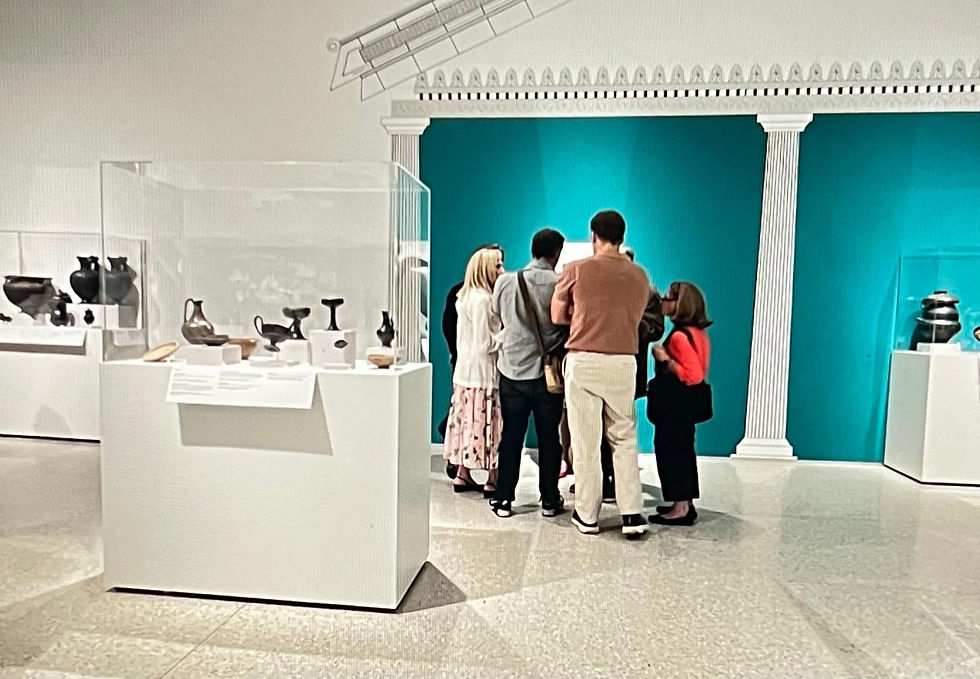
As I stepped into the art exhibition, clusters of people gathered around artifacts to share their
impressions. An informative introduction panel welcomes visitors to Etruscan life. An interesting
fact is that the Etruscans partially deciphered language remains unique and separate from Indo-
European tongues like Latin and Greek. Also, the exhibition explores the Etruscan prosperity
from trade and elite cultural practices, including the high status of noble women, with 70
artifacts spanning 750 years until the 1st century. From all the artifacts of the exhibit, I have
selected four that relate to Etruscan women.
The first artifact I have chosen is Maenad (Figure 1), a terracotta sculpture depicting the
bust of a woman. The woman head, the neck, and the chest show proportional real-life size. The
face smiles and resembles an archaic mouth. She wears a headcloth decorated with a circular hat
known as a tutulus. Her necklace features an acorn-shaped pendant, that is called bullae. Her
tunic, referred to as a palla, is rendered in molded relief. It reflects Roman architectural
influences that trace back to the Etruscans. The figure represents a young woman identified as a
Maenad, a follower of the wine-god Dionysus, that has curly hair and a vivid facial expression.
The artifact is crafted from light brown terracotta. The size is approximately 14 inches tall.

The second artifact is titled Figurative Ash Box (Figure 2), a terracotta funerary urn that
exemplifies Etruscan burial practices’ rich artistic and symbolic traditions. The lid features a
reclining female figure, a common representation of the deceased in Etruscan funerary. The
depiction of the woman lying on top of the urn shows the importance of these women in
Etruscan societies. Also, the urn displays an active battle scene. Despite the seemingly unrelated
imagery, woman and battle, such combinations may carry an essential meaning such as political
and military decisions. Etruscan women held a notable status in society, often depicted with
agency and prominence in funerary artistic representation, which suggests their influence
extended beyond domestic roles.


The third artifact (Figure 3) served Etruscan priestesses as well as priests who were
responsible for discerning the gods’ intentions through observing natural occurrences, a typical
practice involved studying the liver of a sacrificial animal. This item is a reproduction of a
bronze sheep’s liver model utilized in these divinations. Found near Piacenza, Italy, it bears
Etruscan inscriptions and is sectioned in different parts.

The fourth artifact is a Hoop Earring, a tiny, delicate and symbolic piece of jewelry
crafted as a twisted gold loop. At the terminal of the loop is a finely detailed representation of a
woman’s head, adorned with a filigree collar and intricately patterned hair. The head of the
woman suggests a deep cultural significance that reflects the status of women in Etruscan
society; gold, as well as jewelry, are associated with wealth and divine power.
Together, these four artifacts demonstrate the artistic and social significance of women in
Etruscan life. Women’s status, identity, and ritual practices found a place in Etruria. Given this
cultural and historical context, how do these artistic representations call attention to women’s
agency and contributions?
Maenads, as the one illustrated in Figure 1, were considered followers of Dionysus.
Rituals to this god were socially sanctioned and reserved for well-born women. This structured
freedom offered a symbolic break from domestic roles without defying patriarchal norms
entirely. Over time, artistic Maenads’ representations on vases shifted from mythological figures
to women as ordinary citizens. Societal changes took place, which signaled a diminishing
influence of Dionysian wildness as a counterbalance to patriarchal norms. Krista Marie Ubbels 2
warns of the danger of interpreting Maenads universally through contemporary understandings.
In her dissertation, The Maenads: More than Greece’s Good-Time Girls, Ubbels explores how,
unlike the seclusion of Greek and Roman women, Etruscan women were present at banquets,
sporting events, and even public meetings. 3
Also, it is important to know that Romanization, which started around 340s BC and
continued into the Augustan period, led to the assimilation of Etruscan culture and the decline of
the Etruscan political power. Unfortunately, Etruscan women lost many privileges and adopted
the status of Roman women. On the other hand, some Etruscan women influenced Roman
culture. One example is Livia, from the 1st century, Augustus’ wife, who performed as a
counselor. Also, Imperial women like Agrippina, the Younger, preserved political power. 4
Another fact is that Etruscan women attended banquets alongside men, unlike their Greek
contemporaries where democracy was only for men. Due to the freedoms and status enjoyed by
Etruscan women, Roman writers portrayed women negatively, casting their societal roles in an
unfavorable light. Furthermore, Dominique Briquel’s research 5 indicates that archaeological
findings from tombs and funerary artifacts shows the significant role of Etruscan women in
society, particularly in skilled labor such as spinning and weaving. Figure 2, exemplifies how
funerary artifacts reinforced the societal significance of Etruscan women.
Etruscan Women and Nature’s Disruption
For Shiva progress destroys Nature (265). Women who plant and live from the plants and Nature
are pushed aside. Women lose their power to sustain their families and their surroundings.
Spinning and weaving, traditionally central to Etruscan women’s labor, symbolize sustainability
and creation, both deeply tied to Nature.
These practices not only provide economic independence but also reinforce their integral role in maintaining ecological balance. Modern science, Shiva states, operates as a patriarchal construct rooted in domination and reductionism. She argues that the development process, justified as scientific and therefore universally valid, has marginalized women and fragmented Nature, leading to violence and
control. The feminine principle, Shiva propose, serves as an alternative, emphasizing
interconnectedness, non-violence, and ecological sustainability (268).
Shiva critiques the transformation of Nature and the rise of modern science as patriarchal
and exploitative constructs. Francis Bacon’s vision of science sought to control and manipulate
nature, which was no longer revered as a nurturing Mother Nature but reduced to an inert,
lifeless object subject to domination. Shiva mentions Carolyn Merchant who stresses this shift as
culturally significant, enabling the exploitation required by emerging capitalism. The nurturing
image of Earth, which once restrained exploitation, was replaced by images of mastery and
violence, legitimizing the denudation of nature (269).
Shiva reminds us that modern science originated during the Scientific Revolution and it is
portrayed as a project of white, middle-class men, symbolizing power and subjugation. Figures
like Bacon, considered the father of the scientific method, advanced this system to benefit
European male entrepreneurs, while excluding women, ecological perspectives, and holistic
knowledge systems. For Shiva, Nature is the feminine principle (281), a nurturing,
interconnected view of Nature that contrast with the concept of humanity, and the white man,
dominating it. Shiva argues that women produce life. It is not only about biology. It is women
social role as sustaining families, communities and ecologies. This standpoint applies to Etruscan
women by recognizing their pivotal role in nurturing and sustaining both family and society,
much like Shiva’s feminine principle (Shakti).
In the case of Etruria, Roman impositions over other civilization continued to marginalize
women and Nature. Specifically, the shift to Romanization eroded the authority and influence of
Etruscan women, who once played significant roles in political, social, and religious life.
Etruscan women embodied an interconnected relationship with Nature and community, which
was diminished under patriarchal systems, further paralleling Shiva’s concerns about
domination, reductionism, and the loss of ecological balance.
Sacred Femininity
In her essay “Divine Women, Irigaray suggests that for women to attain complete subjectivity,
they need to revere a female deity who can grant them the sense of divinity they are missing -
paralleling the way a patriarchal god bestows divinity upon men. For Irigaray “if women have no
god, they are unable either to communicate or commune with one another” as “[t]here is no
woman God, no female trinity: mother, daughter, spirit” (475). Yet, within the rituals and
mythologies of the Etruscans, this absence of goddesses dissolves. Etruscan women stood in
communion with goddesses who embodied strength, wisdom, fertility and protection.
Unlike the patriarchal structure Irigaray critiques, Etruscan beliefs revered goddesses
such as Uni that is the Goddess of love, marriage, fertility, family, and women. Also, Turan
associated with youth and birds influenced Venus Roman goddess 6 . Female deities likely offered
Etruscan women a spiritual connection and subjectivity that Irigaray advocates for. The presence
of goddesses and the role of women as priestesses shows a society where feminine principles
held central significance. Women fostered both individuality and communal bonds among
themselves. As seen in Figure 3, priestesses used divination’s artifacts.
Beyond Etruscan women roles as priestesses and spiritual guides, Etruscan women may
also have found empowerment via the very concept of beauty, something Irigaray argues has
rarely been wielded for women’s own self-fulfillment. Irigaray says that women “have rarely
used their beauty as weapon for themselves, even more rarely as a spiritual weapon. The body’s
splendor has rarely been used as a lever to advance self love, self fulfillment” (477). For Irigaray
women beauty has been used as a trap for the other. Thus, women’s beauty have often been used
to captivate and to serve others, rather than to empower themselves or foster spiritual growth.
Beauty should be a self-love and fulfillment thing for women.
Etruscan women’s cultural practices offer a counterpoint to Irigaray’s. Etruscan women
were portrayed in art as confident, adorned figures participating in public and private life
alongside men. Etruscan beauty was celebrated not just as an aesthetic quality but as a reflection
of status, agency, and connection to divinity, as seen in their association with goddesses like
Turan. Unlike the patriarchal constructs critiqued by Irigaray, Etruscan women’s beauty could be
seen as intertwined with their social and spiritual roles, embodying both personal and communal
significance. As seen in Figure 4, the Hoop Earring, with its detailed representation of a
woman’s head, reflects the prestige and societal value of Etruscan women, showcasing beauty as
both status and power, an idea that contrasts with Irigaray’s notion of beauty being used as a trap
rather than a tool for self-fulfillment.
For Irigaray, women lack true identity and autonomy, as their roles are often defined by
functions like being married, a virgin, or connected to husbands and children. She questions,
“[w]here is the singleness for women? To be herself beside” (483-4). Irigaray calls for a space
where women can exist as individuals beyond patriarchal societal functions or relationships
dictated by patriarchal impositions.
To close, Shiva’s critique of patriarchal domination via science and Irigaray’s call for
feminine divinity and beauty provide a lens to appreciate Etruscan women’s roles in divinity, in
societal roles as embodiments of ecological balance, autonomy, political and spiritual power.
Etruscan women’s artistic representations reflected authority and spiritual empowerment rather
than passive idealization seen in posterior cultures. The Greek and Roman traditional view of
women’s roles diminished and damaged Western culture’s perception of women. Yet, in
Etruscan society, women’s roles remained visible, a celebration of the feminine rarely seen in
Western societies thereafter.
Footnotes
1 Huber, Kayla. Everybody’s a Little Bit Sexist: A Re-evaluation of Aristotle’s and Plato’s Philosophies on Women. Lake Forest College, Department of History, 25 Feb. 2015.
2 Ubbels, Krista Marie. The Maenads: More than Greece's Good-Time Girls: An Examination in Athenian Image, Text, and Historical Evidence. PhD dissertation, Pennsylvania State University, Graduate Program in Art History, 22 Aug. 2008.
3 What Do We Know about Etruscan Women? | Italy Magazine
4 Donna Hurley. Agrippina the Younger. roman-emperors.org, 2017.
5 Briquel, Dominique. Les Étrusques. Presses Universitaires de France, 2005.
6 N. H. Ramage and A. Ramage, Roman Art, Upper Saddle River, 1996.
Cited Work
Plato. The Republic. Translated by Christopher Rowe, Penguin Classics, 2012.
Irigaray, Luce. “Divine Women”. Women, Knowledge and Reality. Explorations in Feminist
Philosophy. Routledge.1996.
Shiva, Vandana. “Science, Nature and Gender”. Women, Knowledge and Reality. Explorations in
Feminist Philosophy. Routledge.1996.


Comments